 URKL News
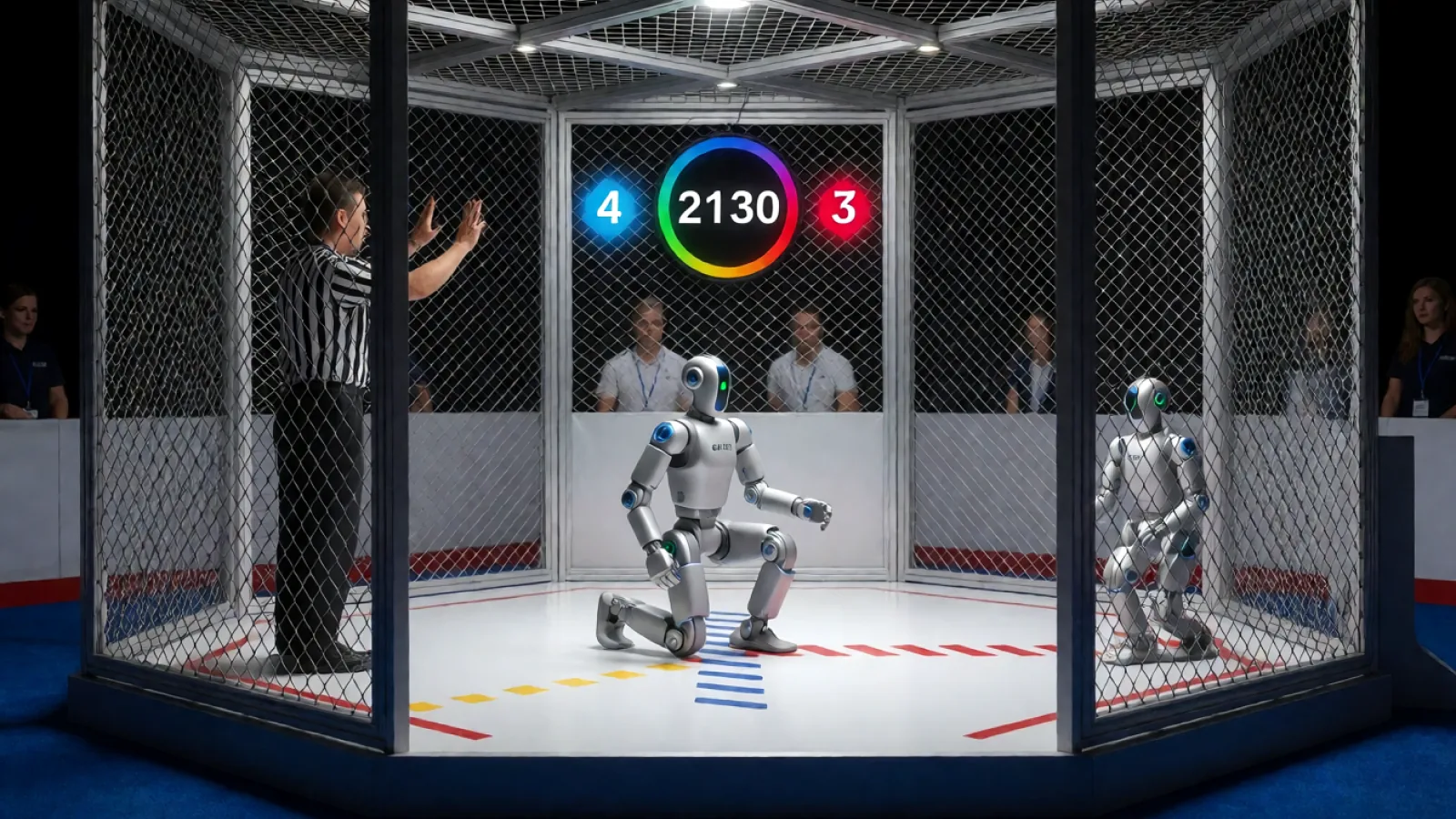
URKL points at a glance
Section 8.5 defines both the scoring action and the body part that must make contact. A strike is not scored simply because it looks dramatic. These are the championship rules, rather than a retroactive scorecard for the Shenzhen opening or Shanghai city-tour event.
| Action | Points | Published requirement | |---|---:|---| | Valid punch | 1 | The elbow or any part of the arm below the elbow contacts the opponent’s head, torso or legs | | Valid kick | 2 | The knee or any part of the leg below the knee contacts the head, torso or legs | | Critical strike | 5 | A qualifying leg strike contacts the opponent’s head, defined as the neck and above | | Taunt, celebration or other interaction | 1 | Lasts at least three seconds, occurs once per round at most, and is valid only while the opponent is down during the referee’s count | | Contact with the opponent’s arms | 0 | Arm contact is not a scoring target |
The referee and judge jointly confirm valid scoring actions during combat. This is not a sensor-only automated points table in the published wording.
Why a critical head kick is worth five, not seven
The critical-strike rule explicitly says its five points are not added to the two points for a valid kick on the same strike.
A qualifying kick to the head is therefore worth 5 points total, not 2 + 5 = 7.
That non-stacking provision is easy to miss in short summaries. It also makes the location of contact decisive: a valid leg strike to the torso or legs is two points, while the same qualifying limb contact to the neck or above falls under the five-point critical-strike rule.
What counts as a knockdown?
URKL uses a broad definition: a robot is down when any part of its body other than the soles of both feet touches the floor.
That means a knockdown is not limited to a robot lying flat after a heavy punch. A hand, knee or another body part touching the mat can meet the definition.
Once the referee begins the count:
- the attacking robot must retreat to a neutral corner;
- the attacking side must stop attacking;
- the downed robot has up to 30 seconds to stand unassisted and resume a fighting stance;
- if it succeeds before the count expires, the count stops and competition resumes.
The rule emphasizes unassisted recovery during the count. A person simply lifting the robot back onto its feet is not the same recovery pathway.
What happens if the robot cannot stand within 30 seconds?
If the downed robot cannot resume competition when the count expires, the match clock stops. The downed team automatically uses its technical-timeout entitlement for that round, beginning a three-minute repair or replacement window.
During that period, the team may perform emergency repairs or adjustments in the arena, or bring in an eligible reserve under the replacement rules. Team members may bring a toolbox; lifting rigs are prohibited. The opposing team may not operate its robot during the suspension.
The possible outcomes are:
- A robot returns in time: competition can continue under the referee’s procedure.
- No robot in the arena can continue when the timeout expires: the team loses the round.
- No robot in the arena or among its reserves can continue: the team is knocked out and loses the match immediately.
Losing a round and being knocked out are therefore related but distinct outcomes. The decisive KO condition is the absence of any machine capable of continuing.
Technical timeouts: one per round, up to three minutes
Each team may request no more than one technical timeout per round, lasting no longer than three minutes.
A designated team member signals with a T-shape made by both hands. The request takes effect only after the referee confirms it with a whistle, and requests made during active engagement are not accepted.
The timeout clock starts when the referee confirms the request. It stops when the robot has returned to the arena and all team members have left the cage.
If the robot cannot return and resume before the three minutes expire, the team loses that round. A team that is not ready after the between-round rest interval can also automatically consume its timeout for the upcoming round.
This makes unused timeout time strategically meaningful. It is not only a repair resource; it can later serve as a match tiebreaker.
ROUND3, ROUND5 and registered robots
Under section 8:
- ROUND3 means a three-round match;
- ROUND5 means a five-round match;
- each round lasts five minutes;
- the rest interval between rounds is three minutes;
- matches other than the third-place match use ROUND3;
- the third-place match uses ROUND5;
- each team may register up to three T800 robots for a match.
The three registered robots are reserves and replacement options, not three simultaneous fighters in this one-on-one rules section. A replaced robot may not re-enter the same match.
Replacement during a round is prohibited unless the referee determines that the arena robot has an evident malfunction and cannot continue. Between rounds, the replacement must be completed within the rest interval and reported to the referee.
How rounds and matches are decided
Round result
At the end of a round, officials apply this order:
- a team ruled to have lost the round gives its opponent the round;
- the higher round score wins;
- if scores are tied, more critical strikes wins;
- if still tied, the round is a draw.
Match result
At the end of the match, the order is:
- a KO winner takes the match;
- without a KO, the team with more rounds won takes the match;
- if rounds are level, higher total score wins;
- if total score is tied, more total critical strikes wins;
- if critical strikes are level, more unused technical-timeout time wins;
- if everything remains tied, the match is a draw.
This order explains why teams cannot focus only on cumulative points. Winning rounds comes before total score when no KO has occurred, and preserving timeout time can matter after several other tiebreakers.
Fouls and penalties that can change a result
Undeclared weapon
Weapons are prohibited. Using an undeclared weapon in the arena results in immediate disqualification.
Late arrival
A team that fails to report for inspection at least 30 minutes before its match forfeits. The opponent receives a 3–0 victory in rounds.
Passive conduct
Deliberately avoiding contact, disengaging to evade combat, falling without being struck or otherwise delaying the contest can be treated as passive conduct. The escalation is:
- first offense: warning;
- second offense: five-point deduction in the current round;
- third offense: match loss recorded as a 3–0 victory for the opponent.
These provisions belong to the section 8 knockout rules. They should not be transferred automatically to an exhibition or another organizer’s event without confirming the applicable rules.
Arena and officiating basics
The section 8 arena is an octagonal cage with an eight-metre inscribed-circle diameter, iron fencing 1.9 metres high, and non-slip combat-sports matting at least 2.5 centimetres thick. Two diagonally opposite corners serve as neutral corners during a knockdown count.
The officiating structure consists of a head referee, referee and judge. The head referee has final interpretive authority, the referee manages the arena and counts, and the judge records scores and fouls.
A written appeal must be submitted within 10 minutes after the match, with a 2,000 RMB appeal fee. The head referee is to review it within 30 minutes. The fee is refunded if the appeal succeeds and retained if it is rejected.
An important rulebook caveat
Section 8 describes 16 teams in a single-elimination knockout stage. Section 4.2 instead describes 16 teams entering groups and eight advancing to a double-elimination finals stage.
Those are different structures within the same V2.0.0 document. This scoring guide uses section 8 specifically for match format, points, knockdowns and results. It does not claim to resolve the broader bracket inconsistency.
For that distinction, see URKL championship vs. city tour. For the earlier pathway into the bracket, read our URKL qualification report. Exhibition and city-tour events may also use special formats, so their results should not automatically be scored through this championship section.
A practical example
Imagine Robot A lands two valid punches and one valid kick to the torso in a round, while Robot B lands one critical kick to the head.
- Robot A: 1 + 1 + 2 = 4 points.
- Robot B: 5 points, not seven.
Robot B would have the higher round score, assuming no other scoring or penalties. If Robot B then touches the mat with a hand, the knockdown rule can start a count even if B was leading on points. Scoring advantage does not cancel the recovery requirement.
This simplified example uses only section 8’s published values; it does not represent a reported official bout.