 URKL News
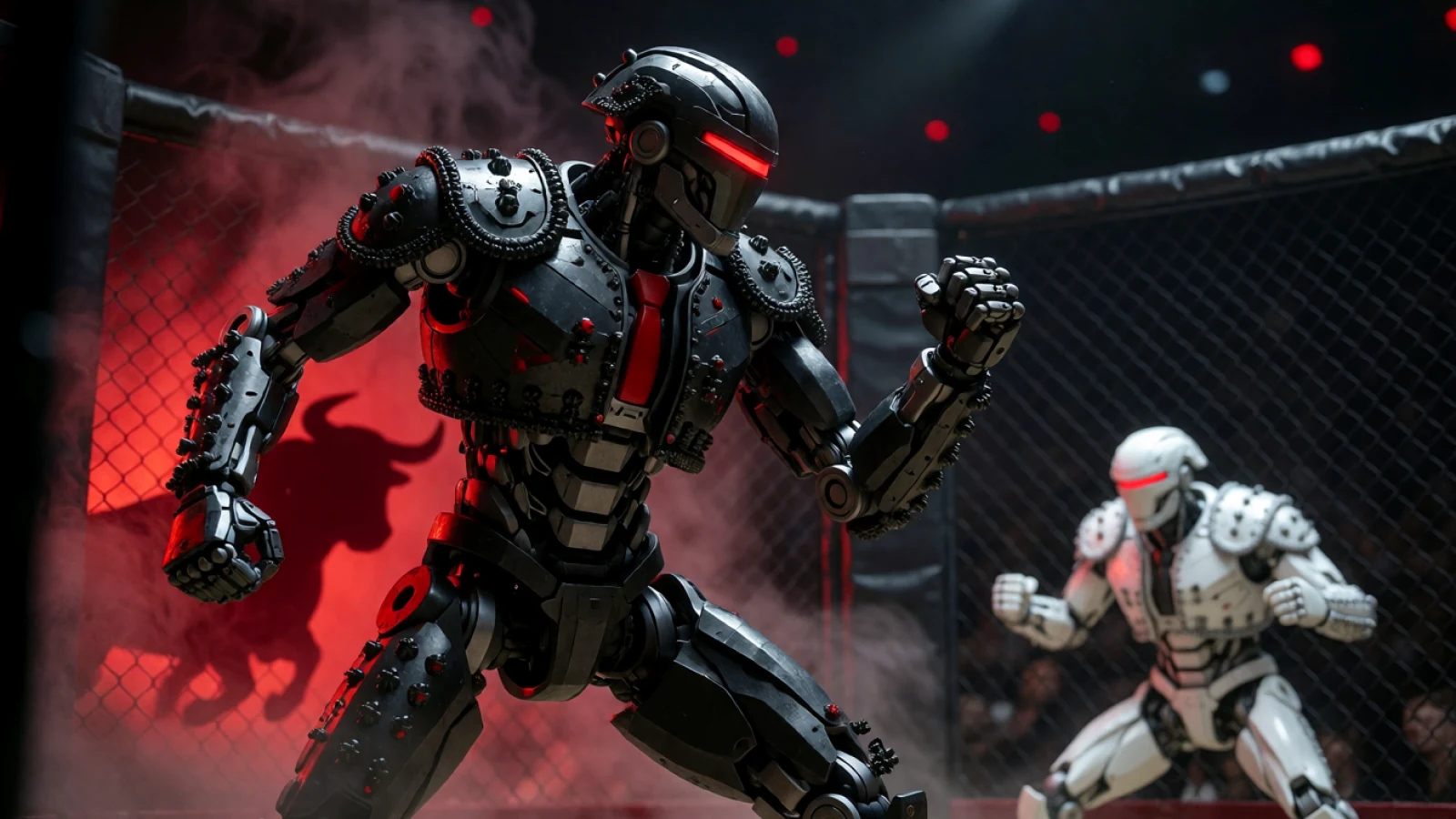
Are Matador and Bullfighter the same robot?
Yes, in the public-event context covered here, Matador and Bullfighter refer to the same recognizable fighting identity. The Nanshan government’s English launch report calls the dark fighter “Bullfighter,” while Chinese and English coverage of later events also uses the Matador name.
The two labels can make search results look like separate competitors. A careful record should therefore group the identities together while preserving the name used by each original source.
| Profile item | Documented information | |---|---| | Names in coverage | Bullfighter; Matador | | Visual identity | Dark armor with contrasting light details | | Standard URKL platform | EngineAI T800 | | Signature opening result | 3–2 decision over White Eagle after five rounds | | Later public appearance | Shanghai city-tour multi-robot finale | | Established championship status | No title confirmed by the cited public-event reports |
This profile concerns the named fighter identity. It does not assume that every dark-colored T800 shown in every URKL clip is necessarily the same physical chassis, team entry or software configuration.
Matador’s documented event record
The following table collects only results that can be tied to the cited reports. It is not a complete career archive.
| Date and event | Reported outcome | Format | |---|---|---| | July 16, 2026 — Shenzhen URKL opening | Bullfighter defeated White Eagle 3–2 | Five-round, one-on-one opening contest | | September 19, 2026 — Shanghai city tour | Matador appeared as the visiting challenger from Shenzhen | City-tour presentation | | September 19, 2026 — Shanghai finale | White Eagle and Golden Flash defeated Matador | Two-against-one showcase |
No official all-time win–loss table is supplied by these sources. In particular, the multi-robot finale should not be counted as an ordinary one-on-one loss without labeling the format.
For the original matchup, see our White Eagle vs. Matador fight report and the Shenzhen event hub. For the later event, read the complete URKL Shanghai results guide.
The Shenzhen win: what the 3–2 result means
URKL’s opening event took place at the Nanshan Cultural and Sports Center. Bullfighter and White Eagle fought for five rounds before Bullfighter was declared the winner by a 3–2 decision.
That score is important for three reasons:
- it identifies Bullfighter as the documented winner of the opening bout;
- it describes a five-round contest rather than a single highlight exchange;
- it belongs to the Shenzhen event, not to every subsequent meeting between the fight identities.
The result does not establish that Bullfighter won a full championship bracket, collected a title belt or defeated every other URKL entrant. Launch-event success and season-championship success are different claims.
Why Matador’s Shanghai appearance was different
Shanghai did not simply recreate the Shenzhen duel. Event reporting framed Matador as the fighter arriving from the opening event to challenge the Shanghai lineup. The concluding showcase then placed Matador against two opponents, White Eagle and Golden Flash.
That creates a fundamentally different tactical situation. A lone robot must account for more than one approaching body, while the pair must avoid obstructing each other. Shanghai’s official recap described distributed perception, relative-position tracking and dynamic roles for the two teammates. These are organizer-provided technical descriptions, not an independent control-system audit.
The result of that finale belongs in Matador’s public event history, but it needs the words two against one whenever it is cited. Removing that context would make the record look like a conventional rematch.
Our Shanghai two-against-one format explainer examines why this showcase differs from a standard championship match.
What is Matador’s fighting style?
Public footage shows a humanoid using boxing, kicking, footwork, guard and recovery actions within the URKL format. However, a few edited clips are not enough to define a stable style in the way a large human combat-sports record might.
A useful style assessment would require repeated evidence for questions such as:
- Does Matador initiate more punches or kicks?
- How often does it score to the head, torso and legs?
- Does it advance aggressively or wait for an opponent’s movement?
- How quickly does it recover after different kinds of falls?
- How does its behavior change between one-on-one and multi-robot formats?
The cited event reports do not provide those statistics. It is therefore more accurate to describe Matador as the dark T800 identity associated with the opening win and later multi-robot showcase than to invent labels such as “knockout specialist” or “defensive champion.”
Is Matador autonomous or remote-controlled?
The control method must be attached to a specific event. URKL’s V2.0.0 knockout rules allow remote control, teleoperation and autonomous strategies, so the league name alone does not answer the question.
Shanghai organizers described fully autonomous fighting at that event, but edited public video does not document every decision or intervention. The Shenzhen launch reporting likewise does not provide a complete layer-by-layer control disclosure for every moment of Bullfighter’s win.
The safest wording is: Matador is a physical T800-based fighter whose exact tactical control configuration should be verified for each appearance. Automatic balance can also operate beneath human-selected actions, so “operator-controlled” and “autonomously stabilized” are not necessarily contradictory.
Matador is not a separate T800 specification
Searchers sometimes treat fight names as if they were hardware editions. Matador is not listed as a fifth T800 product version alongside Basic, Open Source, Pro and Max.
Commercial T800 tables describe configurations with different degrees of freedom, computing and sensing. They do not disclose which complete configuration sat beneath Matador’s exterior during each event. As a result, it would be wrong to assign every top-end T800 feature to Matador without event-specific confirmation.
That caveat does not diminish the performance. It separates what viewers saw in the ring from what a manufacturer lists across a broader product range.
What would confirm Matador’s standing next?
A stronger competitive profile will require official, event-specific information:
- a published opponent and match format;
- complete round results or a documented KO;
- confirmation of whether the match affects a championship table;
- the registered team and robot configuration where available;
- a full video or official replay rather than isolated highlights.
Until then, Matador/Bullfighter’s clearest distinction is its 3–2 opening victory over White Eagle, followed by a visually prominent but structurally different Shanghai appearance. That is a noteworthy early record without needing an unsupported championship label.