 URKL News
What happened in the Shanghai finale?
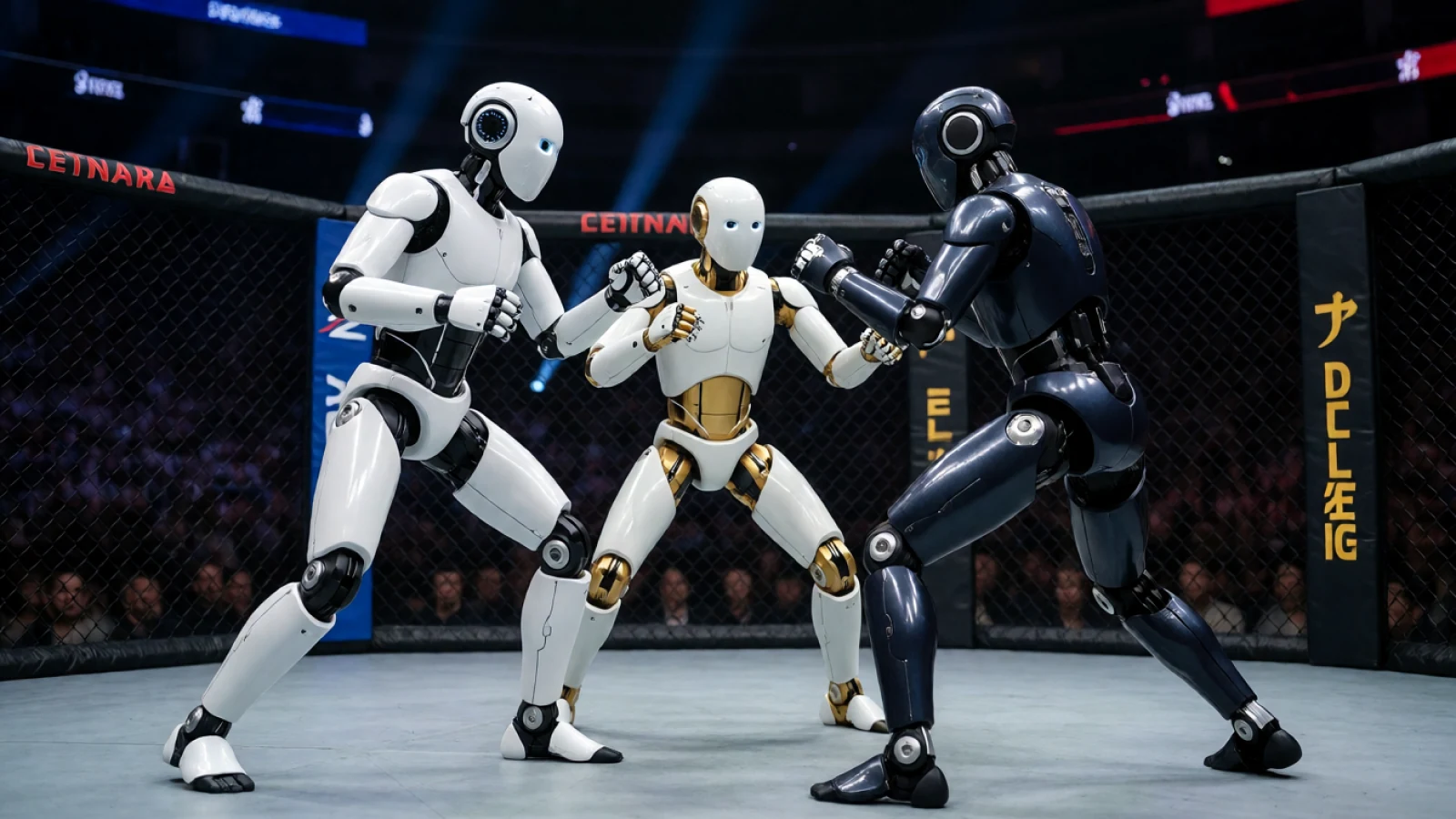
The concluding contest at the Shanghai city-tour event changed the usual geometry of a URKL fight. Instead of two humanoids meeting one-on-one, three T800-based fighting identities occupied the cage:
- White Eagle, in white armor;
- Golden Flash, in gold armor;
- Matador, the dark-armored fighter also called Bullfighter at the Shenzhen opening.
White Eagle and Golden Flash formed the pair. Matador faced them alone. China Daily’s post-event report identified the pair as the winners.
| Detail | Published information | |---|---| | Date | September 19, 2026 | | Event | URKL City Tour Shanghai | | Venue | Baoshan Gymnasium | | Team format | Two against one | | Paired fighters | White Eagle and Golden Flash | | Lone fighter | Matador | | Reported winner | White Eagle and Golden Flash | | Championship status | City-tour showcase, not a published championship standings update |
No complete public scorecard for this finale is supplied in the sources used here. The result should therefore be reported without inventing round scores, knockdown totals or championship points.
Why two against one changes the fight
A normal duel requires each robot to track one principal opponent. A two-against-one format adds problems that cannot be solved by simply running the same policy twice.
The lone robot must divide attention
Matador had to account for two possible sources of movement and contact. Facing one opponent could create exposure to the other, while turning to address the second could change the first opponent’s opportunity.
The teammates must share space
White Eagle and Golden Flash could not both occupy the same useful striking position at the same time. Their movements needed enough separation to avoid collisions and enough coordination to remain relevant to the contest.
Target selection becomes dynamic
A teammate may engage, wait, reposition or change which opponent-related role it is performing. The interesting engineering problem is not merely “two robots attack”; it is deciding who does what, from where, and when.
What URKL said about distributed perception
Shanghai’s official recap described a distributed multi-robot perception system in which observations from the two teammates could complement one another and reduce individual blind spots.
The account also described tracking three-dimensional poses, trajectories and behavior states, followed by dynamic allocation of roles broadly equivalent to:
- restraint or interference, helping control the opponent’s options;
- opportunity execution, taking advantage of an opening.
Those are organizer claims about the system architecture. Public video can show coordinated-looking movement, but it cannot independently prove the exact data shared, algorithm used or degree of human supervision throughout the finale.
The careful conclusion is that Shanghai publicly demonstrated a multi-robot format and presented it as coordinated autonomous behavior according to the event organizers.
Relative positioning is as important as striking
Three full-size humanoids create a crowded contact environment. Each machine needs a workable estimate of where the others are, not only where the opponent’s head or torso appears in a camera image.
For the paired robots, useful relative-position information includes:
- distance between teammates;
- distance and angle to Matador;
- available space around the cage;
- whether a planned step crosses a teammate’s path;
- whether one robot is falling or recovering.
This is why collision avoidance matters even when the robots are on the same side. A technically powerful strike is not useful if its setup causes a teammate to lose balance or blocks the only recovery route.
For a deeper engineering explanation, see our companion analysis of multi-humanoid coordination.
This was not three reserve robots fighting at once
URKL’s section 8 championship rules allow a team to register up to three T800 robots for a match. That provision concerns available machines and replacement, not a standard three-robot simultaneous lineup.
The same section describes championship matches as one-on-one. Shanghai’s finale therefore needs a separate label: a special city-tour multi-robot demonstration.
Confusing reserves with simultaneous fighters would radically misstate both the rules and the result. A team can have spare machines without placing all of them in the cage together.
Does the result settle White Eagle vs. Matador?
No. Bullfighter/Matador won the documented Shenzhen opening contest against White Eagle 3–2 in a five-round one-on-one fight. Shanghai’s two-against-one outcome does not reverse that result or constitute an equal-format rematch.
The two records should remain separate:
- Shenzhen: Matador/Bullfighter defeated White Eagle one-on-one.
- Shanghai: White Eagle and Golden Flash defeated Matador two against one.
That distinction protects the meaning of both performances. It also gives fans a reason to want a properly documented future one-on-one rematch rather than pretending one has already happened.
Our White Eagle profile and Matador/Bullfighter profile keep these event contexts separate.
What the video proves—and what it does not
Available footage shows physical robots sharing the cage, moving, making contact and falling. That is enough to establish that the multi-robot presentation was a real physical event rather than a purely digital simulation.
Edited footage does not establish:
- every robot’s control mode at every moment;
- whether any reset or intervention occurred between shots;
- the complete sequence of exchanges;
- an official round-by-round score;
- whether the same coordination system would succeed in repeated unedited trials.
These are evidence limits, not accusations. They define the difference between watching a public demonstration and independently benchmarking the underlying technology.
Why the format matters for URKL’s future
The Shanghai finale expanded URKL beyond the visual language of a conventional boxing or MMA bout. It showed that the event property can experiment with team tactics, asymmetric numbers and coordinated movement.
That creates entertainment possibilities, but it also creates a need for explicit rules. Before multi-robot contests become a formal competitive category, organizers would need to clarify scoring, knockdowns, repairs, teammate interference, ring safety and how a result affects standings.
For now, the best description is precise and limited: Shanghai hosted a documented two-against-one city-tour finale, the paired side won, and the organizers used it to showcase multi-robot coordination.